
Beirut Through the Ages: A City That Refuses to Be Forgotten
Beirut Through the Ages: A City That Refuses to Be Forgotten
Few cities on Earth have been destroyed and rebuilt as many times as Beirut. Sitting at the crossroads of East and West, this ancient Mediterranean port has endured conquests, earthquakes, wars, and explosions — yet each time, it rises again. The history of Beirut is not just the story of a city; it is the story of resilience itself. From its days as an Ottoman port to its current identity as a modern capital still healing from its wounds, Beirut has always been a place where civilizations meet, collide, and create something entirely new.
In this journey through old Beirut, we trace the arc of a city that has served as a Roman law school, an Ottoman trading hub, a French-mandated capital, a glamorous playground of the 1950s, a battlefield, and a phoenix of reconstruction. Each era left its mark — in architecture, in culture, and in the spirit of its people.

Beirut around 1900 during the final years of Ottoman rule, showing the port city's characteristic red-roofed stone buildings and Mediterranean waterfront.
The Ottoman Era: Beirut as a Rising Port City (1516–1918)
For four centuries, Beirut under Ottoman rule transformed from a modest coastal town into one of the eastern Mediterranean's most important ports. When the Ottomans first took control in 1516, Beirut was a small settlement overshadowed by larger cities like Tripoli and Sidon. But a series of developments in the 19th century would change everything.
The Rise of Commerce and Education
By the mid-1800s, Beirut had become a thriving commercial center. The opening of a modern port in 1894, connected by road to Damascus, made the city a gateway between Europe and the Arab interior. Silk, olive oil, and tobacco flowed through its docks. Foreign merchants — French, British, and American — established trading houses along the waterfront.
Perhaps more transformative than commerce was education. The Syrian Protestant College (later the American University of Beirut) was founded in 1866, followed by the Université Saint-Joseph in 1875. These institutions turned Beirut into the intellectual capital of the Arab world, nurturing the writers, thinkers, and activists who would shape the region's future.
Architecture and Urban Character
Ottoman-era Beirut was a city of red-roofed stone houses, narrow souks, and elegant mosques. The Grand Serail, built in 1853 as an Ottoman military barracks, still stands today as the seat of the Lebanese prime minister. Photographs from this period — rare and precious — show a city of modest scale but undeniable charm, its harbor filled with sailing vessels and its hillsides dotted with mulberry trees.
The Ottoman period also saw the emergence of Beirut's famous cosmopolitanism. Muslim, Christian, Druze, and Jewish communities lived side by side, each contributing to the city's cultural mosaic. This pluralism would become Beirut's defining characteristic — and, at times, its greatest challenge.
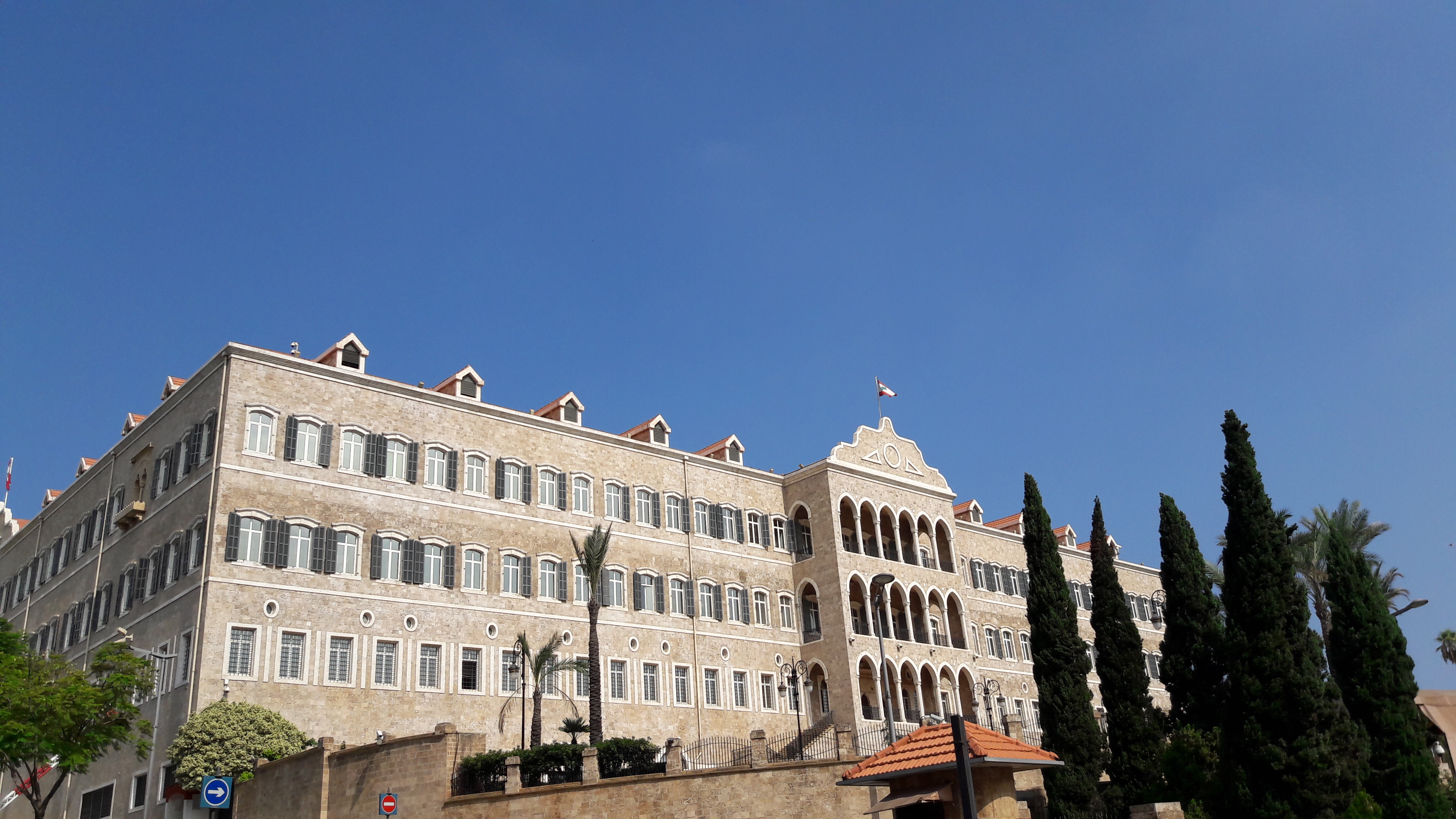
The Grand Serail in Beirut, originally built in 1853 as Ottoman military barracks and now serving as the seat of the Lebanese prime minister.
The French Mandate: A New Identity (1920–1943)
When the Ottoman Empire collapsed after World War I, France was granted a mandate over Lebanon by the League of Nations. The creation of Greater Lebanon in 1920, with Beirut as its capital, marked a turning point in Lebanon history. The city was no longer just a port — it was the center of a new nation.
Parisian Boulevards and Mediterranean Light
The French mandate left an indelible mark on Beirut's physical landscape. Wide boulevards replaced Ottoman-era lanes. Art Deco and Neo-Ottoman buildings rose along new avenues. Place de l'Étoile, modeled after its Parisian namesake, became the heart of the new downtown, its clock tower a symbol of the emerging Lebanese state.
French became the language of the elite, joining Arabic and, increasingly, English in Beirut's linguistic repertoire. Cafés in the French style appeared along the Corniche. The city's cuisine — already a blend of Ottoman, Arab, and mountain traditions — absorbed French influences that persist to this day.
Seeds of Independence
Yet the French mandate was never wholly welcomed. Lebanese nationalists agitated for independence throughout the 1920s and 1930s. The struggle came to a head in 1943, when Lebanon declared independence. The French initially arrested the new government, but popular protests and international pressure forced them to relent. On November 22, 1943, Lebanon became a sovereign nation, and Beirut became the capital of the only Arab country with a Christian president — a unique arrangement that reflected the city's pluralistic identity.
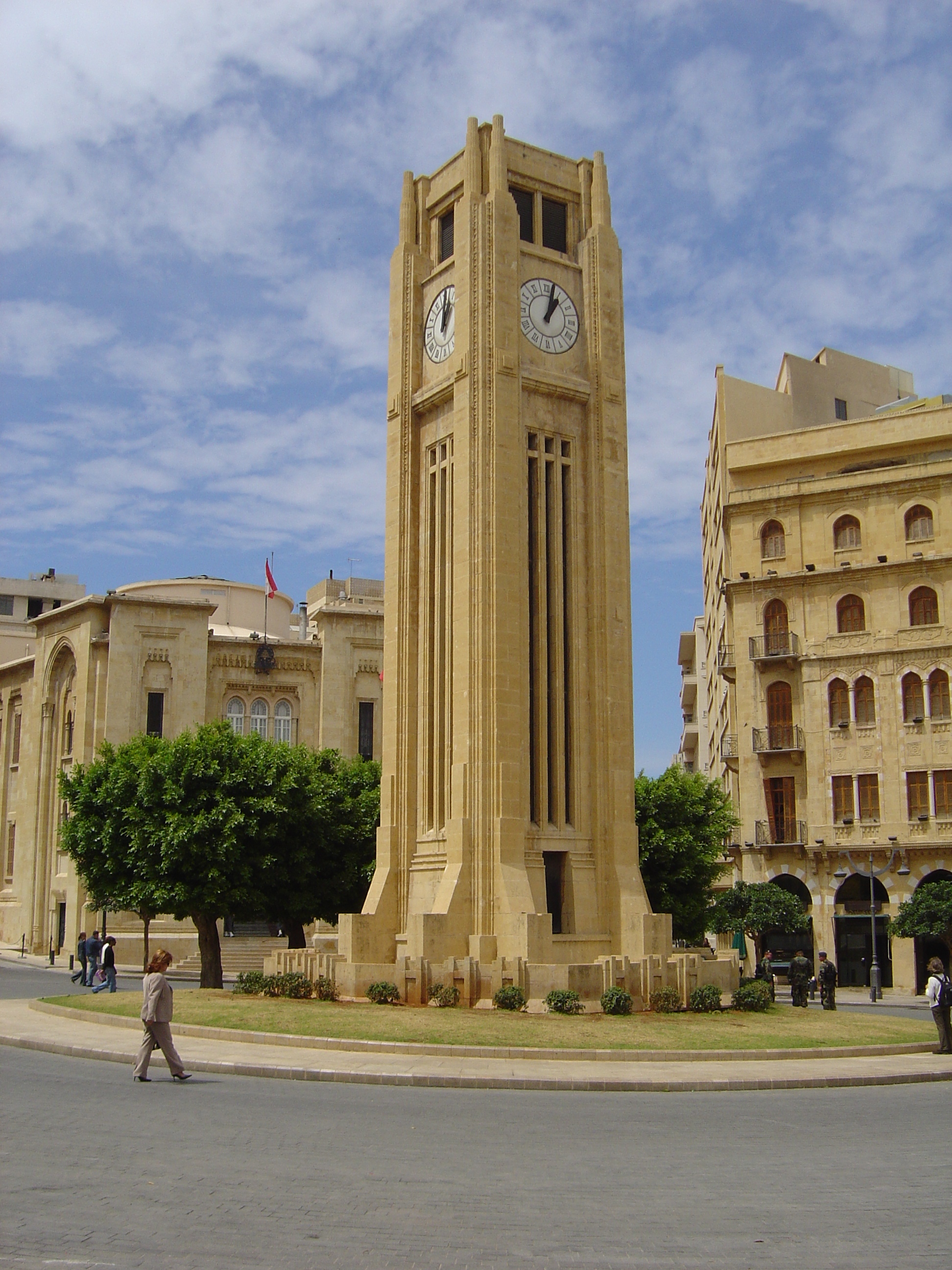
Place de l'Etoile in downtown Beirut, modeled after its Parisian namesake during the French mandate period, with its iconic clock tower.
The Golden Age: Beirut in the 1950s and 1960s
Ask anyone who remembers old Beirut, and their eyes will light up at the mention of the 1950s and 1960s. This was Beirut's golden age — the era when the city earned its most famous nickname: "the Paris of the Middle East."
A Playground for the World
In the postwar decades, Beirut became a magnet for artists, intellectuals, spies, and jet-setters. Its banks, operating under strict secrecy laws modeled on Switzerland's, attracted capital from across the Arab world and beyond. The Hotel Saint-Georges and the Phoenicia Hotel hosted film stars, oil sheikhs, and diplomats. Nightclubs like Les Caves du Roy drew crowds until dawn.
Beirut photos from this era tell a vivid story: women in miniskirts walking along Hamra Street, sports cars parked outside modernist apartment buildings, crowded beaches stretching from Raouché to Jounieh. The city was glamorous, cosmopolitan, and seemingly invincible.
Cultural Capital of the Arab World
Beyond the glitz, Beirut in its golden age was a serious intellectual center. Publishing houses produced Arabic literature that was read from Morocco to Iraq. Newspapers operated with a freedom unmatched in the region. The city became a haven for political exiles — Palestinians, Iraqis, Syrians — who found in Beirut the freedom to write, organize, and dream.
Music flourished as well. Fairuz, Lebanon's most beloved singer, performed at the Baalbek International Festival, her voice carrying across the ancient Roman ruins. The festival itself became a symbol of Lebanon's unique position — a modern Arab nation deeply connected to its ancient, pre-Islamic heritage.

Martyrs' Square (Place des Martyrs) in Beirut -- once the vibrant heart of the city before the civil war devastated the downtown area.
The Civil War: A City Torn Apart (1975–1990)
The golden age ended with devastating abruptness. On April 13, 1975, a bus carrying Palestinian passengers was attacked in the Ain el-Rummaneh neighborhood, igniting a civil war that would last fifteen years and claim over 120,000 lives. Beirut, the city of coexistence, became a city divided.
The Green Line
A demarcation line — known as the Green Line for the vegetation that grew in the abandoned no-man's-land — split Beirut into East (predominantly Christian) and West (predominantly Muslim). The downtown area, once the vibrant heart of the city, became a shattered wasteland of snipers and rubble.
The destruction was not merely physical. The civil war shattered the myth of Lebanese exceptionalism — the idea that this small, pluralistic country could somehow avoid the conflicts that plagued its neighbors. Families were displaced, communities were separated, and an entire generation grew up knowing nothing but war.
Survival and Resilience
Yet even during the darkest years, Beirut refused to die. Universities continued to operate. Newspapers continued to publish. People found ways to cross the Green Line for work, for love, for life. The resilience of Beirut's inhabitants during the civil war is one of the most remarkable — and least told — stories of the 20th century.
Photographers who documented the conflict captured images that are both heartbreaking and strangely beautiful: children playing in bombed-out buildings, women hanging laundry on balconies pocked with bullet holes, militia fighters posing with weapons in front of Coca-Cola billboards. These Beirut photos from the war years are essential documents of a city's suffering and survival.

War-damaged buildings along the former Green Line in Beirut, bearing the scars of the 1975-1990 Lebanese Civil War.
Reconstruction: The Hariri Era and Beyond (1990–Present)
When the civil war finally ended with the Taif Agreement in 1989, Beirut lay in ruins. The task of rebuilding fell largely to Rafik Hariri, a billionaire businessman who became prime minister in 1992. His vehicle was Solidere, a private company that undertook the reconstruction of Beirut's devastated downtown.
A Controversial Rebirth
Solidere's reconstruction was ambitious and controversial. The company demolished many war-damaged buildings that preservationists argued could have been restored, replacing them with sleek towers and luxury developments. Critics accused Hariri of erasing Beirut's history to build a playground for the wealthy. Supporters countered that the city needed a bold vision to recover.
The result was a downtown that gleamed with new construction but felt, to many longtime residents, soulless. The old souks were replaced by a high-end shopping mall bearing the same name. Roman ruins were excavated and preserved, but surrounded by glass-and-steel towers that dwarfed them.
New Wounds
The assassination of Hariri himself in 2005, killed by a massive car bomb on the Corniche, plunged Lebanon into fresh crisis. The Cedar Revolution that followed — massive protests demanding Syrian withdrawal from Lebanon — showed that the spirit of Beirut's people remained unbroken. But political instability, economic crisis, and the devastating port explosion of August 4, 2020, have tested the city's resilience as never before.
The Beirut port explosion, one of the largest non-nuclear explosions in history, destroyed entire neighborhoods and killed over 200 people. It also obliterated many of the Ottoman and mandate-era buildings that had survived the civil war — a loss not just of property but of irreplaceable Lebanon history.

Downtown Beirut after reconstruction -- a modern city center built over layers of ancient, Ottoman, and mandate-era history.
Beirut's Enduring Spirit
To walk through Beirut today is to walk through layers of history stacked upon each other like archaeological strata. A Roman bathhouse sits beneath a parking lot. An Ottoman-era house leans against a French mandate apartment building. A bullet-scarred high-rise towers over a trendy café where young Lebanese discuss politics over coffee and arguileh.
The history of Beirut is not a linear narrative of progress. It is a cycle of destruction and renewal, of loss and reinvention. Each era — Ottoman, French, golden age, civil war, reconstruction — has left its imprint on the city's stones and on the memories of its people.
What makes Beirut extraordinary is not that it has suffered — many cities have suffered. It is that it has always come back. The same cosmopolitan energy, the same creative defiance, the same insistence on life and pleasure and beauty in the face of catastrophe. This is the spirit that has made Beirut one of the most compelling cities in the world for thousands of years, and it is the spirit that will carry it into whatever comes next.
"Beirut is the city that never gives up. It has been destroyed seven times and rebuilt seven times. It will be destroyed an eighth time and rebuilt an eighth time." — Lebanese proverb
About Native Threads
At Native Threads, we believe in preserving and celebrating the rich cultural heritage of the Middle East and North Africa. Our designs are inspired by the history, architecture, and identity of the region — from the ancient souks of Beirut to the cedar-crowned mountains of Lebanon.
Explore our Lebanese Emblem Collection — apparel that carries the symbols and spirit of Lebanon's enduring identity. Each piece is a wearable connection to the history, resilience, and beauty that defines this remarkable land.
Leave a comment